Key takeaways
- Invisalign is best for mild to moderate cases, adults who don't want metal showing, and patients who'll wear the aligners 22 hours a day.
- Traditional braces are the strongest tool for complex tooth movements, big bite corrections, and patients (especially kids and teens) who'd rather not manage removable trays.
- Both work. The right choice usually comes down to the complexity of your case and how disciplined you are about wearing aligners.
The short version
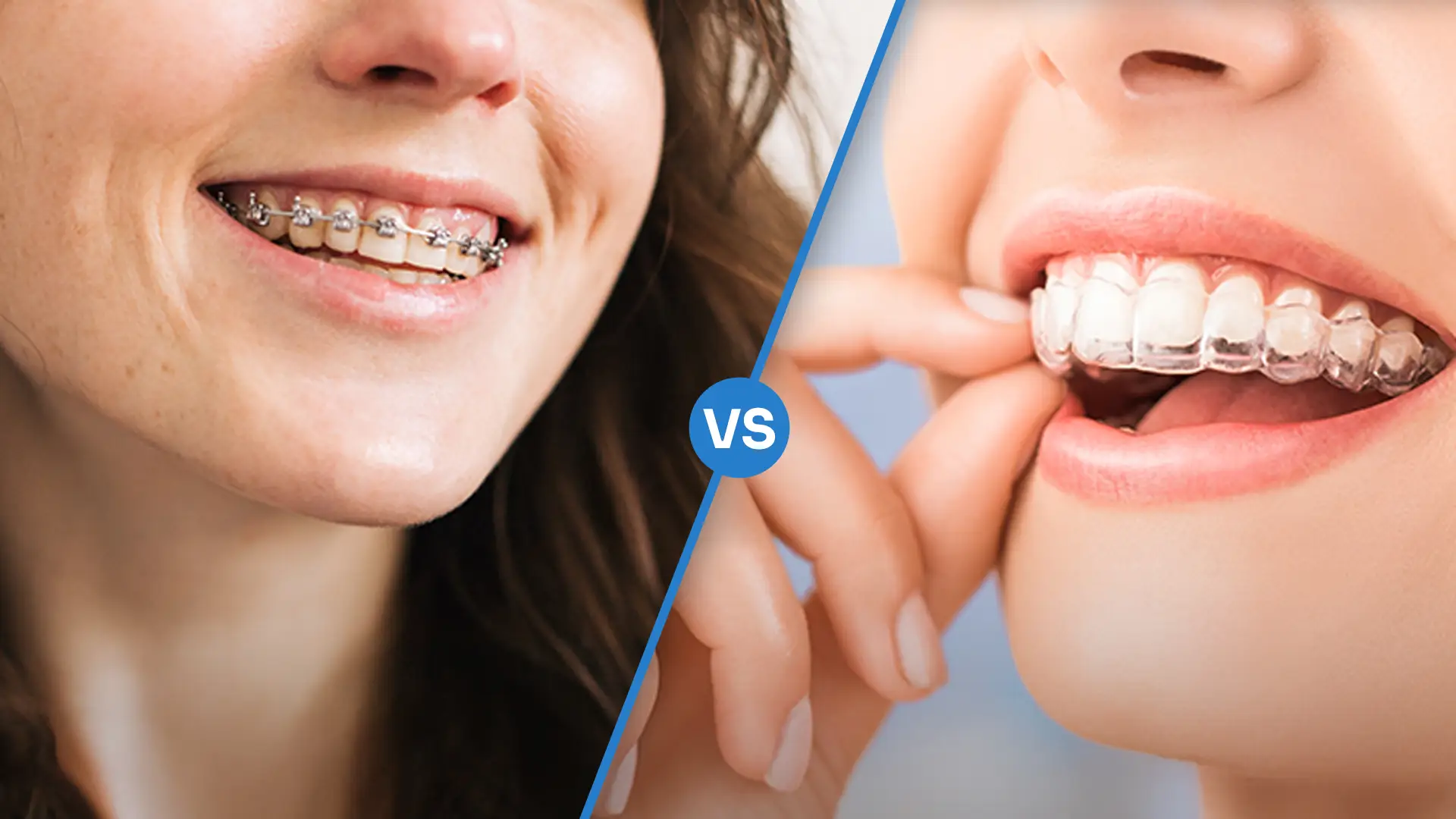
Invisalign uses a series of clear plastic trays that shift your teeth in small steps. Braces use metal brackets glued to each tooth, connected by a wire that's adjusted every 4–8 weeks.
Both move teeth using the same biological principle — applying steady, gentle pressure — but they get there in different ways.
Cost comparison
| Traditional braces | Invisalign | |
|---|---|---|
| Houston cost range | $3,500–$6,500 | $4,500–$7,500 |
| Insurance coverage | Usually 50% up to $1,500–$2,500 | Usually same as braces |
| Payment plans | Yes, in-office and 3rd-party | Yes, in-office and 3rd-party |
| Total visits (avg) | 20–30 | 8–12 |
Invisalign is typically a bit pricier than braces — partly because the lab fabricates dozens of custom trays in advance, partly because Invisalign is a brand with its own pricing.
Treatment time
For most cases, the timelines are surprisingly similar:
- Mild cases — both finish in 6–12 months.
- Moderate cases — both run 12–18 months.
- Complex cases — braces 18–30 months; Invisalign may run longer or require treatment add-ons.
The bigger driver of treatment time isn't braces vs Invisalign — it's how complicated your case is.
When braces are the better tool
Traditional braces still outperform Invisalign for:
- Severe crowding where teeth need to move large distances or rotate significantly.
- Major bite corrections — deep overbites, underbites, or open bites.
- Vertical movement of teeth (pulling a tooth down or pushing it up into the gum line).
- Patients who won't wear aligners for the required 22 hours a day — usually kids, teens, or anyone who'd find that level of discipline frustrating.
- Cases that need elastics, expanders, or other auxiliary appliances alongside the main treatment.
Braces also tend to be the more economical option for complex teen treatment plans.
When Invisalign shines
Invisalign is often the better choice for:
- Adults in client-facing jobs — the aligners are nearly invisible from conversational distance.
- Mild to moderate crowding or spacing — the trays handle these elegantly.
- Patients who care about easy hygiene — you remove the trays to brush and floss normally.
- People who play wind instruments or contact sports — brackets and wires can be uncomfortable in both situations.
- Adults who had braces as kids and need a small touch-up.
The honest trade-offs
With braces:
- You can't take them off until treatment is done.
- Flossing is harder — most patients use a water flosser or floss threaders.
- Avoid sticky and hard foods (popcorn, hard candy, ice, caramel) that can pop brackets off.
- Soreness for 2–3 days after each adjustment is normal.
With Invisalign:
- You must wear them 22 hours a day. If you take them out for lunch and a coffee meeting and forget to put them back in, that day doesn't count toward treatment.
- You'll change trays every 1–2 weeks.
- Some cases need "attachments" — small tooth-colored bumps glued to teeth so the aligners can grip them. These make Invisalign less invisible than the marketing suggests.
- You need to brush after eating before putting trays back in, or stains and decay build up under them.
What about other "invisible" aligner brands?
ClearCorrect, SureSmile, Spark, and mail-order options like Byte or Smile Direct Club all exist. The big distinction:
- Doctor-supervised aligners (ClearCorrect, SureSmile, Spark) work with a dentist or orthodontist who monitors your treatment in person — similar quality to Invisalign, often a few hundred dollars less.
- Mail-order aligners skip the in-person exam. They're cheaper but have come under serious scrutiny for causing tooth and gum damage in patients whose cases weren't appropriate for that approach. We don't recommend them.
How we decide together
At your consultation, we'll do a 3D scan and review:
- The complexity of your bite and tooth positions
- Your lifestyle and how realistic 22-hour daily wear is
- Your budget and insurance benefits
- Your preferences on appearance during treatment
For about 70% of adult patients we see, both options will work — and we'll walk you through the trade-offs so you can choose. For the other 30%, the right answer is clearly one or the other, and we'll tell you which.
See our braces and Invisalign page for more on what to expect, or book a consultation and we'll get you a personalized plan and quote in one visit.
Common questions
Can I switch from braces to Invisalign mid-treatment, or vice versa? Sometimes — but it usually adds time and cost. The better path is choosing the right tool up front.
Are clear ceramic braces an option? Yes — tooth-colored brackets are a middle ground: they're less visible than metal, more visible than Invisalign, and a bit more fragile. They cost roughly the same as metal braces.
How long do I wear a retainer after? For life, ideally. Teeth want to drift back. Most patients wear retainers nightly after the first year — a small investment to protect what you just paid for.
Will I have a lisp with Invisalign? A mild lisp for the first few days is common — your tongue adjusts quickly. By week two most patients sound normal.